"Let us not be ashamed to speak what we shame not to think."
-Michel de Montaigne

Wednesday, June 8, 2011

What Color Parachute Would You Like?


I feel like 27 is some sort of critical age. Which is a stupid 27-yr-old thing to say, I know, but it *feels* true nonetheless. The truth is EVERY age is a critical age, but it is only now that I'm starting to feel like possibility and limitation are scaled in equal measure before me. And that is an entirely new prospect for many people in their late twenties.

What I mean is this: you never tell a 5 year old that they're being unrealistic when they say they want to be an astronaut/President of the United States/ballerina/doctor/pirate/NBA star/firefighter. Our own cynicism might quietly *think it*, but, for all you know that freakin' kid MIGHT ACTUALLY DO IT. Who knows? Life is before them. Possibility outweighs limitation. But at 27, the field narrows. What was once an open meadow is now this scraggly little path winding up Work Mountain.

But the funny thing is, I'm finding this narrowing to be a sort of blessing.

I have a dear friend who is pulling his hair out trying to decide what to do with the rest of his life. Ah, that question: what to do, what to DO with our remaining youth, our remaining work years? He's prayed. He's discussed. He's researched. He's sought counsel. What he hasn't done, in my humble opinion, is be quiet. Quiet enough to have an objective discussion with himself. All of his understandable fretting has made me think about my own career trajectory, and in retrospect I find it ironic that my true passions were illuminated only after I recognized and accepted the limitations I have. I had to have the cajones to be painfully honest with myself and my desires before I could start reaping any joy from the work that was, in fact, sucking up my youth.

For me, teaching was a disaster. Not because I wasn't good at it, or because I didn't like the kids, or because the pay was bad (and it was). I LOVED my students, and by all accounts I was a stellar teacher. But, and here's the thing, I felt like I was extinguishing some essential part of me in order to do it. If it had been my "calling" all of that work would have been nutritious for my soul instead of draining, taxing, toxic. This is not to say that our passions should come easily, but rather, the work that comes as a result should grow us, feed us.

The narrowing of the field has helped me to zero in on what I want my life to look like, really. Not what I think my life should look like. And for the first time, I'm starting to see glimpses of the dreams I began as a girl. At fifteen I read and fell in love with The House on Mango Street by Sandra Cisneros. At 22 I taught this book to my 9th grade students. And now, at 27, I've received a note from Sandra Cisneros herself saying she loves my poems, lauds my future in writing. How else could that have happened, ever, if I hadn't been honest with myself about my desire to become a poet no matter how daft it made me look to other people?

I may never achieve any measure of *success* where writing is concerned. And I am, in fact, a no-name in the publishing world. But I'm totally okay with that because I am living a life that looks and feels exciting to me. Thank God the field is narrow for me now. Thank God I've had the good fortune of falling on my face hard enough to know now what I want. Bring on my thirties and beyond: I'm ready to run through them, torch in hand.

Thursday, April 21, 2011

Pity Party for One, Anyone?


I've kept a journal since I was probably...10? For the last 17 years, I've chronicled every awkward phase (or, I should say, every phase of a perpetually awkward life), every heartbreak and new love, nearly every vacation, most of my harebrained book ideas/poem drafts/sketches of random strangers on NYC subways. My diary has been with me on the bank of the Seine, the beaches of Hawaii, and in the hospital room where my daughter was born. My diary contains the eulogy I wrote and read at my father's funeral.

I think it's a peculiar thing that people should even have the impulse to journal. Some might think it is an inherently narcissistic motivation--this desire to archive the minutiae of one's existence. Who, after all, stands to benefit from your illegible musings besides you? But narcissism or not, I was incredibly grateful for my journals the other night when I was in the midst of a pity party for one.

I've been in a weird place professionally and creatively. An odd purgatory where I've had enough success or achievement to lodge a foot in the door, but not enough to actually be invited in. Last week I was battling a hefty double punch of self-pity: I'd received two rejection emails from literary magazines I was hoping to publish in, and I was dealing with an unmitigated sense of loser-ness in the prospect of my future career as an academic librarian.

And as I retreated to my journal to commemorate it, I noticed that I only had one page left to write. Not only that, I was finishing my journal EXACTLY a year to the date that I'd started it. I figured it was a sign. Divine intervention. So I gave the first entry a reread.

What I wrote about myself was this, "For what purpose am I here? Failed poet and sappy diarist. Overblown ego and burning heart."


That one line in particular, "failed poet," prompted me to read my diary from start to finish. I wanted to know if that statement still felt true a year later.

What I realized after reading my diary was this: I had grown tremendously as a woman, as a writer in the past year. When I wrote those things I was coming from a place of brokenness having made the difficult decision to leave my teaching career behind, and feeling insecure in my capabilities as a writer. But in the year since I penned those statements I wrote two manuscripts worth of poems, won a poetry prize, secured publications in three fantastic literary journals, nearly completed a Master's degree, and conquered some personal issues that had been previously crippling.

That's when it hit me--this understanding of the transformative power of journaling--the unique treasure of being able to rediscover yourself and grow from the retrospective examination of who you were, are, or wanted to be at any given point in your own personal history. As my pastor likes to say, "That's good stuff." Good stuff indeed.

I felt reborn after rereading the ups and downs of the previous year. I was ready to become my own cheerleader. I was ready to steam forward into my next journal, and whatever next phase lay ahead of me with some genuine joy in my heart. For my last entry, instead of lamenting my rejection slips and lack of professional security--I wrote a list of specific ways I had grown over the last year, and another list of traits I'd like to develop in myself going forward.

Page one might read "failed poet," but the final page has yet to be written.

Friday, March 18, 2011

What the National Archives is Teaching Me About the Disaster in Japan

Given the recent tragedy in Japan, and the impending nuclear crisis that resulted--I find a sense of amorphous History haunting me as I process the records from the Manhattan Project as a volunteer for the National Archives and Records Administration (NARA).

Something that's always fascinated me as a writer, student, and just as a human being in general, is the notion of History being omnipresent, or not even really History at all.

What I mean is, when I touched the cold limestone of the Notre Dame in Paris, I thought of plague victims from the 14th century leaning their feverish bodies against the same cool exterior. I thought of Napoleon Bonaparte walking down the center aisle in an ermine robe, snatching the crown from Pope Pius VII and placing it on his own head. When I interlace my stubby brown fingers with my husband's long pale white fingers and walk down the streets of Atlanta, I know that perhaps some of the eyes that see this small act of public intimacy also witnessed the protests and death it took to allow it. None of those things that we call 'History' seems very far away from me, from my life as a woman living in 2011.

In my hot little hand yesterday, I held a blue print that showed the nuclear reactor used in Oak Ridge, Tennessee to process the Uranium needed to power the first atomic bomb, dropped on Hiroshima in 1945. Later that same day, I went home and scrolled through images, and read in-depth commentary on the Fukushima nuclear reactors threatening to wreak havoc unseen since Chernobyl.

The images of Japanese men and women crying over leveled homes gave me chills. It was like time woke up from a feverish nightmare repeated again with slightly different details:

Hiroshima, 1945
Courtesy of Million Face

Miyagi Prefecture, 2011
Courtesy of Business Insider

Since I began processing this collection, I've gone through hundreds of pieces of paper that might seem mundane to the average person--shipment records, correspondences, charts and tables, blue prints. But the reality of it is this, History (if we can call it that) is made through a conglomeration of individual acts. It so rarely occurs as a result of an unprecedented earthquake, but when it does, we are still tested by the weight of our smallest decisions.

I feel very differently today about nuclear technology and the ramifications of our work as Americans in the Manhattan Project. Not just because of the problems Japan faces now, but certainly in light of them. A sense of remorse. A sense of unease. A sense of we-can-do-better-than-this. There are 50 or so Japanese workers risking life and limb right now to try to exterminate the nuclear reactors that threaten their nation. They, and their countrymen are being tested by their daily acts of service, community, and sacrifice. I am inspired by that, truly, and I feel like we could learn something from that here in America.

If it is in your power, or realm of concern, considering donating to a fund that you trust that is working to provide aid to disaster victims in Japan such as MercyCorp or Unicef.

Let us not be the generation that idly grieves when we might act. Passive sympathy is as inexcusable as active cruelty. At the very least, let us be the generation that respects History as a living thing that we participate in and can change.

Wednesday, February 16, 2011

Oh Writer's Block, Thou Art a Black Dog from Hell


What are you supposed to do when the inspiration just sort of...stops?

From March to December 2010, I wrote about 250 poems. That's an average of 27.77777778 poems per month--just shy of a poem a day. We had a good run, me and poetry. This creative burst came after years of neglecting poetry in the wake of endless academic papers, lesson plans, reports, and email. I never made that choice consciously, to stop writing poetry--but being a good little student and careerist, poetry seemed like a selfish indulgence.

But then I attended a writers conference, my first, and I arrived ready to go to battle: with two fully-groomed non-fiction book proposals, business cards, a binder of writing samples, and my best I'm-a-serious-but-hip-writer-glasses a la Jonathan Franzen. I had a couple of promising bites for my book proposals, but it was the poetry that stood out the most for the editors I met, particularly one who was kind enough to actually sit and talk shop for an entire hour. My poetry? But those were the writing samples I had shoved in the binder at the last minute to show "range." I was nominated for the conference poetry award, and while I didn't win, it was an awakening of sorts. It reminded me of who my first love was, and had always been. That was the beginning of our love affair.

Luckily poetry had not divorced me in favor of someone who took her more seriously over the years.


And now, nearly a year after that fateful conference, I find myself writing blog entries during my hallowed poetry time. Every time I've tried to put any poems down the last 7 weeks or so, I've hated them. Hated them. They've felt forced/trite/too-overworked/too aware of themselves/too you're a sad woman with an English degree stop kidding yourself.

So I'm left with the question, what do you do when you hit this wall? Some thoughts:


1) Talk to other writers--I've met some A-mazing writers in the last year. Both in the academic circuit and online. People that I feel privileged to have met, and I know to a great extent that this will benefit me in the long run. Not so much because of the obvious networking piece, but more because I believe when great minds interact a piece of them is taken away in the other. It's a kind of magic osmosis, a blending and rejecting of ideas, aesthetics, and principles that might have never occurred to you, sitting alone in front of your laptop.

2) Go do something other than writing for a bit: This is not to say that you shouldn't continue to labor on your writing in some way daily, but I think it's good to add something new to the mix. Any good trainer will tell you that you will hit a weight-loss plateau after awhile. Usually this is cured by adding new elements to the workout regiment. What will this look like for me? Well, let's just say I have my first session with Sheneka Rosser trainer extraordinaire this coming Saturday. Have you ever seen a morbidly obese half-Asian female poet? Well have you?! No. Not gonna happen here. Facebook/Google images has officially killed the whole illusion that you can be a writer who cares nothing for your appearance. You don't have to be a sex symbol, but you can't look like the uni-bomber either. I know how shallow that sounds, but it seems naive or deceptive to tell a writer otherwise.

3) Get cozy with the business end of writing: Writing is like a mullet, dude. You can't have the party in the back without the business in the front. It isn't a mullet if you take one or the other away. When the muse departs, it's a perfect time to get to business--start studying literary mags you admire, reading articles by their editors, following AND commenting on industry blogs, becoming a part of the dialog in some way.

4) Stay positive:
This is SO easy to tell someone else. I've told my writerly friends, "Hey, you're in a gathering season right now, that's all." Now it's time to put my money where my new-age mouth is. And I will remind myself that you can't write like you're on fire all the time or we'd all be dead by 25. And I will remind myself that I should like to sustain the fire over a lifetime. And I will I espouse the model of Sharon Olds over Sylvia Plath where life-writing-sanity-balance is concerned.

And that is precisely what I will do until inspiration rockets down into my brain like brimstone. In the interim, pass the 10lb weights--I'm busy getting ready for my new purple tankini.

*What do you do when you hit writer's block--I mean, your "gathering season"?

Tuesday, February 1, 2011

La Literati Interviews: Anthony Madrid


I first noticed Chicago-based poet Anthony Madrid in AGNI online. His poem "If I Am a Total Washout as a Lover (and I Am)" lured me in with its playfulness and tongue-and-cheek wit; but it was his latest manuscript, The 580 Strophes that set the hook deep in my throat.

Can I get an amen for trite-but-otherwise-apt fishing metaphors? Amen. Forget it. You'll amen me after you spend some time with his poetry. Read on, take notes:

Q: One of the things that initially struck me about your poems was this sense of highbrow finesse that was accessible to the "common" reader—a reader perhaps not initially aware of some of the allusions you incorporate. It seems to me that many poets pander to either academia or the plainspoken, whereas your poems have the potential to please both, aesthetically. Is this a conscience effort? Do you consider who will receive your poems when you write them?

You're talking about all those literary allusions. I'll tell you what that is. That's my having been fucked up for life by reading T.S. Eliot when I was a junior in high school. All those footnotes, back of The Wasteland—? That stuff looked to me like this great big heap of unbetterable awesomeness. And still pretty much does. I—don't really expect to recover.

So, no, I'm not conscious of any balancing act. I just write what I like. Like every other good little twit out there.

Q: You've got an impressive list of publication credits—snagging coveted spots in AGNI, Boston Review, Iowa Review, Poetry, and Copper Nickel among others. Do you have any wisdom to impart for poets attempting to break into the world of these competitive journals?

Ha. Copper Nickel looks funny in that list.

Do I have any wisdom to impart. I don't. Every one of those acceptances was a Slush Pile Special. Nobody had heard of me. I was nothing. Which I still pretty much am.

I can tell you what I did, though. It's stupid. I wrote the whole book first, and then sent all those poems out at once. Theory was that I would suddenly be everywhere. "Who is this guy?" and so on. Classic naive shit. That was 2008.

But then good things started happening. I got picked up at Web Conjunctions early. That's good visibility. It's how Robert and Mary found me. And then there was AGNI Online. I think Chris saw me there. Poetry was maybe a year later.

All this is irrelevant. There are gazillions of people who have been in all those places and it doesn't mean jack.

Q: Why poetry? Why you? And why do you refer to yourself in the 3rd person so frequently?

Ay ay ay.

Why poetry/why me. The real reason I got into poetry is 'cuz I was very, very vain about the expressiveness of my talk, all through my childhood. I liked that, and I liked my handwriting—but that's it. I had no other sources of satisfaction. I looked like shit; I didn't have an idea in my skull; I was perpetually excusing myself so I could go into the bathroom and cry with rage. Need I say more? Anyone answering this description would become a poet.

Now, why third person. Oh, that's just this good thing I got from the Urdu poetry I worship. All those guys with their ghazals, they end their poems with these sudden shifts into third person. Berryman of course does this too, and everybody goes into total bliss. I don't know why it's so good, but it is. And so I do it.

Q: You've said previously that poets should consider, if not rely on, being read and experienced aloud. Some people might disagree with this, as the majority of poetry's consumption happens between a solitary reader and the printed word. Why do you think it's important to construct a poem with oration in mind?

Oh, I don't want to insist on this point. There's all kinds of perfectly good stuff that would never in a million years work at a reading, and that's fine. All I'm saying is I know ALL THESE PEOPLE who are so fun and exciting in real life, and will write you emails crackling w/wit and drama and opinion and all the rest of it, and then you turn to their poetry and it's like this soup of evenly-distributed hydrogen atoms. No fun, no drama, no opinion, no one's talking, and nothing is being said. But I think if these poets would just take the presentation-before-a-live-audience thing seriously, and write as if the idea was that you have to get out there and kick the ball down the field and then fffooompf put it in the net, maybe this whole poetry operation wouldn't look like such a drag half the time.

Q: Your latest work is called The 580 Strophes. For the non-English majors, explain what a strophe is, and why you want to change modern poetic form with it?

Part 1. What is a strophe. Strophes are when the poem is made out of a buncha same-sized scoops of talk, all in a row. Think verses in a song. Verse, verse, chorus, verse—this kind of thing. The verses are strophes.

A strophe is not the same thing as a stanza, though. 'Cuz you can have a poem where the stanzas are all totally irregular in length. The point of "strophic structure" is you get a rhythm going:

blah blah blah blah blah blah BLAH?
blah blah blah blah blah blah BLAH!

blah blah blah blah blah blah BLAH?
blah blah blah blah blah blah BLAH!

and so on. The whole point is the rhythm. Once you get it going, it actually seems annoying to break with it. This is somehow the nature of rhythm.


Part 2. Why do I think strophic structure is going to save the world. Basically? because people secretly want poetry to be rhythmic. That is my sincere belief. I'm not saying metrical; I'm saying rhythmic. They want the poet to jump in the hole and start shoveling out same-sized scoops of neat talk. It's just good to do that. But people are ashamed of it. They think, Oh well that's boring, that's monotonous. Yeah, well, if it is, how come songs are all like that, and it's not a problem there?

Rhyme too! People love that shit; they just don't know it. And since they're all terrified that they might be doing something their MFA guru would sneer at, they write these poems that look like blackboards at MIT. Oh boy, aren't we all having fun being "interesting"—! Except it sucks.

(I hate every last one of the "New Formalists," by the way, so don't start getting ideas. My la-la here has nothing to do with "participating in a tradition" or "proving you're a disciplined craftsman" or any of that. It's all about rhythm and rhyme as drugs. That's their justification; that's their glory. Anything beyond that issues directly from the Devil's anus.)

Q: You get to take credit for having written one poem in history. What is it, and tell us why.

That's easy. I'd like to have written Ecclesiastes. King James Version, babe. There's stuff in there that causes me to squirt tears, virtually every time I look at it. And I look at it all the time. That and Revelation are like favorite CDs I take down and play whenever I need a lift.

(Better mention: I have no religion.)

Q: What should Madrid fans keep their eyes on, going forward? What's your next move/project/piece?

"Madrid fans." That's rich. (Hi, Mom! How did you find this blog?)

Actually, I'll tell ya, my "next project" is → I want that book out. The 580 Strophes. I need that thing published, and I need to get the hell out of grad school. If I could have those two wishes, I don't need a third.

Madrid, as I have come to call him, is quite modest considering what he is doing with his poetry. In a poetic climate where writers tend to either rebel from the perceived pompousness of the high-brow, or run to impress/outdo other career writers without pausing to welcome the unwashed masses, Madrid's poetry offers something savory to both the ultra-violet academic and the unschooled lover of words. Something that is exciting, fresh, and within the confines of a consistent poetic form. Something that is, at times, simultaneously campy and high art. My advice? Keep your eye on Madrid. You won't be disappointed.

Thursday, December 23, 2010

Finding Stories in Unexpected Places


You know those random papers you have laying around your house? Tax forms, loan records, letters, paycheck stubs? That stuff is History. No, really. The everyday paper stash of our lives tells the story of our time, although it may not be all that apparent at first glance.

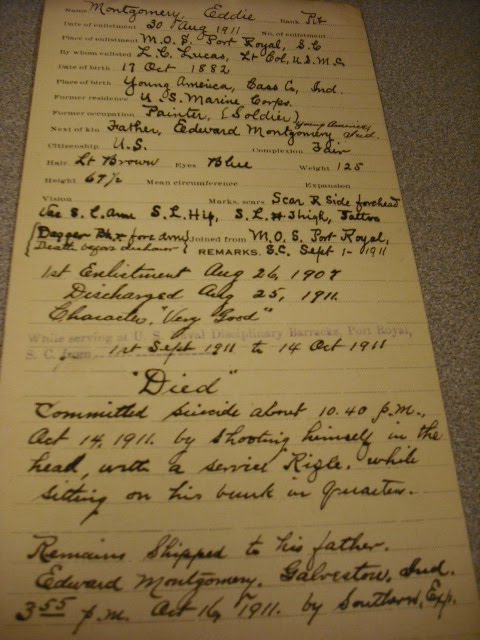
Recently I've begun volunteering for the National Archives and Records Administration (NARA) as an archival assistant. I've just finished my first project--creating a database of WWI Navy enlistee records from Port Royal, South Carolina. This is the first time I've had the opportunity to process records like these, and I came away with so much.

Some things I've learned from the WWI enlistee records:

1) Everything you own can be listed on one page: When an enlistee deserted or died, a full inventory of his possessions was made. Items generally included military-issue clothing, toiletries, and a few letters. What stayed with me is this realization that what we leave behind physically is incredibly transitory and insignificant compared to the life we've lived.


2) Military tedium can teach us a little about how to run our business: Part of the records included a weekly and monthly report of strengths and weaknesses, and a detailed account of how many soldiers were present, sick, needed, and the general quality of operations at Port Royal. There was a system of perpetual self-assessment that nearly any individual or business would do well to mimic. There is this quote by Robert Brault that sort of summarizes this, "Know thyself, or at least keep renewing the acquaintance." Any institution or individual that ever made any real progress was willing to do the difficult work of looking in the mirror. A lot.


3) Self-descriptions are telling: Technically this is not a part of the records I processed, but it's worth mentioning. NARA is the official repository for the national collection of WWI draft registration cards. The cool thing is that they have the registration cards of some very famous (and infamous) people--Al Capone, T.S. Eliot, Rudolph Valentino, and Robert Frost among others. The way registrants describe themselves is interesting. Harry Houdini, godfather of magicians, listed himself as an "actor" under occupation. That's a revealing statement isn't it? Actor? Self-descriptions can be incredibly poignant, even if they are somewhat inaccurate; particularly in retrospect. How might Hitler have described himself? A painter and idealist?

4) After everything else is gone, stories remain: I've gone through approximately 200+ enlistee cards and files, but what stays with me are the stories. The deserters. The soldiers casted-off into government hospitals for the insane. The suicide cases. The nineteen-year-old enlistee who died in a bar fight. The immigrant enlistees who came to America and earned medals for outstanding service to the U.S. Navy. Through these seemingly banal records, letters, and reports--our collective American history unfolds like a beautiful hidden flower. Lives come off the paper for me when I find someone with my birthday, hailing from my hometown, or bearing a 'Death Before Dishonor' tattoo. The time between generations seems so much smaller, and I am inspired, having found so many stories in unexpected places. I think this is the reason why genealogy becomes so encompassing for many people, because of this sense of connection despite the continuum of time.


The WWI enlistee records I mentioned will be available to researchers and genealogists soon. If you're a History enthusiast or just a curious onlooker like myself, come on down to NARA and take a look. You may find much, much more than you anticipated.

Friday, December 17, 2010

The Face of Homelessness


"We must live together as brothers, or perish together as fools."

-Martin Luther King Jr.


This week the temperature in Atlanta dropped to an unprecedented low for this time of the year, clocking in at 15 degrees Fahrenheit this past Tuesday morning. Walking to work from my car, completely unprepared for the sudden shock of winter weather, I could only think: how do the homeless do it?

The truth is I already knew the answer to this question, in part, because I've been homeless. Twice in fact. I am the face of homelessness.


When I was a young child, about 2 or 3, my mother and I were homeless for awhile. I don't really remember it, but my mother has told me stories of us sleeping in her car. The lights and rattling of the city bus would frighten me, so she'd place a blanket over my head at night to help me sleep. In the morning we'd wake, and wash ourselves in a Taco Bell bathroom.

As an undergraduate student, after a series of unfortunate financial and personal circumstances, I found myself homeless again. I was an Honors student sleeping on the subway. Every penny I had, I scraped together to afford the 2.5 hour bus ride to and from college, and the occasional item from the dollar menu to feed myself. During the day I walked around New York City visiting free places like St. John's cathedral or the NYPL to stay warm. Luckily I still managed to look presentable, or even these luxuries would have been denied to me by well-meaning security guards protecting patrons or customers from the uncomfortable reminder of poverty in their midst. Now I work at one of the finest research institutions in the world. I go home everyday to a comfortable and modest house. I am well-fed and have insurance and the luxury of time to be able to write. I'm nearly finished with my Master's degree.

I say this not to brag about some arduous journey that I've come through victoriously, but rather, to say I could very well be homeless again. And so could you.

Lately I've learned that Atlanta, my own city, has the highest rate of homeless children in America. I've also recently read about the alarming increase of tent cities across America. In Florida alone there are a projected 8,000 people living in the woods near Disney World. While tourists spend nearly $100 in admission for the privilege of playing in a fantasy world, 8,000 people live in the shadows of Cinderella's castle in pop-up tents, cooking their food in coffee cans. Please understand, I am not condemning people for wanting a good time. But I do feel that there must be some sort of coming together as a society, or we will perish.

I don't know where I am going with this post emphatically, other than to say that something's got to change in this country. We need to wake up. Stop bum-rushing stores and trampling each other for gizmos from China, and start looking at each other, talking to each other again. Start helping one another with the same voracity we use to please ourselves. Not just because it's cold outside. Not just because it's nearly Christmas. But because our collective fate is determinant upon it. Because it's time to be human again. Because the true success of our lives is measured by what we do to help one another chip away at the overwhelming struggle that life guarantees.

One small step we can take is to understand the face of homelessness. It is not always the crazed beggar on the train, or the limbless veteran downtown that you give change to on occasion. It is families. Children. Someone's impoverished grandma. It could be the Honors student you sit next to in class. It could very well be you.

Check out this article by The Huffington Post about tent cities in America.

Get the latest facts about poverty in America.

Connect with a local charity you care about.

Say 'No' to the extravagant and indulgent lifestyle we've come to accept as the American Dream, and live within your means.