"Let us not be ashamed to speak what we shame not to think."
-Michel de Montaigne

Tuesday, February 1, 2011

La Literati Interviews: Anthony Madrid


I first noticed Chicago-based poet Anthony Madrid in AGNI online. His poem "If I Am a Total Washout as a Lover (and I Am)" lured me in with its playfulness and tongue-and-cheek wit; but it was his latest manuscript, The 580 Strophes that set the hook deep in my throat.

Can I get an amen for trite-but-otherwise-apt fishing metaphors? Amen. Forget it. You'll amen me after you spend some time with his poetry. Read on, take notes:

Q: One of the things that initially struck me about your poems was this sense of highbrow finesse that was accessible to the "common" reader—a reader perhaps not initially aware of some of the allusions you incorporate. It seems to me that many poets pander to either academia or the plainspoken, whereas your poems have the potential to please both, aesthetically. Is this a conscience effort? Do you consider who will receive your poems when you write them?

You're talking about all those literary allusions. I'll tell you what that is. That's my having been fucked up for life by reading T.S. Eliot when I was a junior in high school. All those footnotes, back of The Wasteland—? That stuff looked to me like this great big heap of unbetterable awesomeness. And still pretty much does. I—don't really expect to recover.

So, no, I'm not conscious of any balancing act. I just write what I like. Like every other good little twit out there.

Q: You've got an impressive list of publication credits—snagging coveted spots in AGNI, Boston Review, Iowa Review, Poetry, and Copper Nickel among others. Do you have any wisdom to impart for poets attempting to break into the world of these competitive journals?

Ha. Copper Nickel looks funny in that list.

Do I have any wisdom to impart. I don't. Every one of those acceptances was a Slush Pile Special. Nobody had heard of me. I was nothing. Which I still pretty much am.

I can tell you what I did, though. It's stupid. I wrote the whole book first, and then sent all those poems out at once. Theory was that I would suddenly be everywhere. "Who is this guy?" and so on. Classic naive shit. That was 2008.

But then good things started happening. I got picked up at Web Conjunctions early. That's good visibility. It's how Robert and Mary found me. And then there was AGNI Online. I think Chris saw me there. Poetry was maybe a year later.

All this is irrelevant. There are gazillions of people who have been in all those places and it doesn't mean jack.

Q: Why poetry? Why you? And why do you refer to yourself in the 3rd person so frequently?

Ay ay ay.

Why poetry/why me. The real reason I got into poetry is 'cuz I was very, very vain about the expressiveness of my talk, all through my childhood. I liked that, and I liked my handwriting—but that's it. I had no other sources of satisfaction. I looked like shit; I didn't have an idea in my skull; I was perpetually excusing myself so I could go into the bathroom and cry with rage. Need I say more? Anyone answering this description would become a poet.

Now, why third person. Oh, that's just this good thing I got from the Urdu poetry I worship. All those guys with their ghazals, they end their poems with these sudden shifts into third person. Berryman of course does this too, and everybody goes into total bliss. I don't know why it's so good, but it is. And so I do it.

Q: You've said previously that poets should consider, if not rely on, being read and experienced aloud. Some people might disagree with this, as the majority of poetry's consumption happens between a solitary reader and the printed word. Why do you think it's important to construct a poem with oration in mind?

Oh, I don't want to insist on this point. There's all kinds of perfectly good stuff that would never in a million years work at a reading, and that's fine. All I'm saying is I know ALL THESE PEOPLE who are so fun and exciting in real life, and will write you emails crackling w/wit and drama and opinion and all the rest of it, and then you turn to their poetry and it's like this soup of evenly-distributed hydrogen atoms. No fun, no drama, no opinion, no one's talking, and nothing is being said. But I think if these poets would just take the presentation-before-a-live-audience thing seriously, and write as if the idea was that you have to get out there and kick the ball down the field and then fffooompf put it in the net, maybe this whole poetry operation wouldn't look like such a drag half the time.

Q: Your latest work is called The 580 Strophes. For the non-English majors, explain what a strophe is, and why you want to change modern poetic form with it?

Part 1. What is a strophe. Strophes are when the poem is made out of a buncha same-sized scoops of talk, all in a row. Think verses in a song. Verse, verse, chorus, verse—this kind of thing. The verses are strophes.

A strophe is not the same thing as a stanza, though. 'Cuz you can have a poem where the stanzas are all totally irregular in length. The point of "strophic structure" is you get a rhythm going:

blah blah blah blah blah blah BLAH?
blah blah blah blah blah blah BLAH!

blah blah blah blah blah blah BLAH?
blah blah blah blah blah blah BLAH!

and so on. The whole point is the rhythm. Once you get it going, it actually seems annoying to break with it. This is somehow the nature of rhythm.


Part 2. Why do I think strophic structure is going to save the world. Basically? because people secretly want poetry to be rhythmic. That is my sincere belief. I'm not saying metrical; I'm saying rhythmic. They want the poet to jump in the hole and start shoveling out same-sized scoops of neat talk. It's just good to do that. But people are ashamed of it. They think, Oh well that's boring, that's monotonous. Yeah, well, if it is, how come songs are all like that, and it's not a problem there?

Rhyme too! People love that shit; they just don't know it. And since they're all terrified that they might be doing something their MFA guru would sneer at, they write these poems that look like blackboards at MIT. Oh boy, aren't we all having fun being "interesting"—! Except it sucks.

(I hate every last one of the "New Formalists," by the way, so don't start getting ideas. My la-la here has nothing to do with "participating in a tradition" or "proving you're a disciplined craftsman" or any of that. It's all about rhythm and rhyme as drugs. That's their justification; that's their glory. Anything beyond that issues directly from the Devil's anus.)

Q: You get to take credit for having written one poem in history. What is it, and tell us why.

That's easy. I'd like to have written Ecclesiastes. King James Version, babe. There's stuff in there that causes me to squirt tears, virtually every time I look at it. And I look at it all the time. That and Revelation are like favorite CDs I take down and play whenever I need a lift.

(Better mention: I have no religion.)

Q: What should Madrid fans keep their eyes on, going forward? What's your next move/project/piece?

"Madrid fans." That's rich. (Hi, Mom! How did you find this blog?)

Actually, I'll tell ya, my "next project" is → I want that book out. The 580 Strophes. I need that thing published, and I need to get the hell out of grad school. If I could have those two wishes, I don't need a third.

Madrid, as I have come to call him, is quite modest considering what he is doing with his poetry. In a poetic climate where writers tend to either rebel from the perceived pompousness of the high-brow, or run to impress/outdo other career writers without pausing to welcome the unwashed masses, Madrid's poetry offers something savory to both the ultra-violet academic and the unschooled lover of words. Something that is exciting, fresh, and within the confines of a consistent poetic form. Something that is, at times, simultaneously campy and high art. My advice? Keep your eye on Madrid. You won't be disappointed.

Thursday, December 23, 2010

Finding Stories in Unexpected Places


You know those random papers you have laying around your house? Tax forms, loan records, letters, paycheck stubs? That stuff is History. No, really. The everyday paper stash of our lives tells the story of our time, although it may not be all that apparent at first glance.

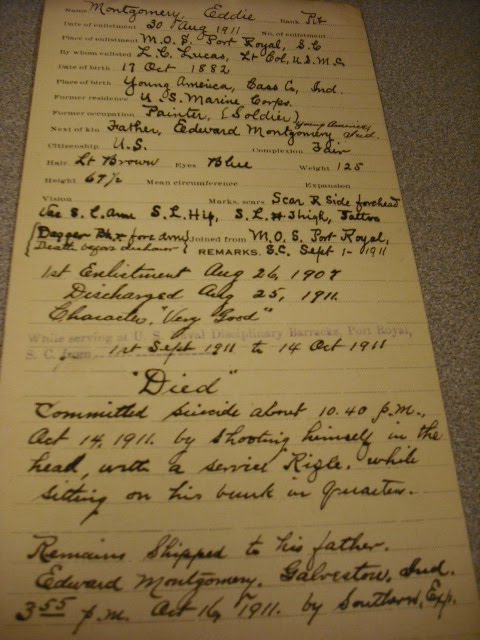
Recently I've begun volunteering for the National Archives and Records Administration (NARA) as an archival assistant. I've just finished my first project--creating a database of WWI Navy enlistee records from Port Royal, South Carolina. This is the first time I've had the opportunity to process records like these, and I came away with so much.

Some things I've learned from the WWI enlistee records:

1) Everything you own can be listed on one page: When an enlistee deserted or died, a full inventory of his possessions was made. Items generally included military-issue clothing, toiletries, and a few letters. What stayed with me is this realization that what we leave behind physically is incredibly transitory and insignificant compared to the life we've lived.


2) Military tedium can teach us a little about how to run our business: Part of the records included a weekly and monthly report of strengths and weaknesses, and a detailed account of how many soldiers were present, sick, needed, and the general quality of operations at Port Royal. There was a system of perpetual self-assessment that nearly any individual or business would do well to mimic. There is this quote by Robert Brault that sort of summarizes this, "Know thyself, or at least keep renewing the acquaintance." Any institution or individual that ever made any real progress was willing to do the difficult work of looking in the mirror. A lot.


3) Self-descriptions are telling: Technically this is not a part of the records I processed, but it's worth mentioning. NARA is the official repository for the national collection of WWI draft registration cards. The cool thing is that they have the registration cards of some very famous (and infamous) people--Al Capone, T.S. Eliot, Rudolph Valentino, and Robert Frost among others. The way registrants describe themselves is interesting. Harry Houdini, godfather of magicians, listed himself as an "actor" under occupation. That's a revealing statement isn't it? Actor? Self-descriptions can be incredibly poignant, even if they are somewhat inaccurate; particularly in retrospect. How might Hitler have described himself? A painter and idealist?

4) After everything else is gone, stories remain: I've gone through approximately 200+ enlistee cards and files, but what stays with me are the stories. The deserters. The soldiers casted-off into government hospitals for the insane. The suicide cases. The nineteen-year-old enlistee who died in a bar fight. The immigrant enlistees who came to America and earned medals for outstanding service to the U.S. Navy. Through these seemingly banal records, letters, and reports--our collective American history unfolds like a beautiful hidden flower. Lives come off the paper for me when I find someone with my birthday, hailing from my hometown, or bearing a 'Death Before Dishonor' tattoo. The time between generations seems so much smaller, and I am inspired, having found so many stories in unexpected places. I think this is the reason why genealogy becomes so encompassing for many people, because of this sense of connection despite the continuum of time.


The WWI enlistee records I mentioned will be available to researchers and genealogists soon. If you're a History enthusiast or just a curious onlooker like myself, come on down to NARA and take a look. You may find much, much more than you anticipated.

Friday, December 17, 2010

The Face of Homelessness


"We must live together as brothers, or perish together as fools."

-Martin Luther King Jr.


This week the temperature in Atlanta dropped to an unprecedented low for this time of the year, clocking in at 15 degrees Fahrenheit this past Tuesday morning. Walking to work from my car, completely unprepared for the sudden shock of winter weather, I could only think: how do the homeless do it?

The truth is I already knew the answer to this question, in part, because I've been homeless. Twice in fact. I am the face of homelessness.


When I was a young child, about 2 or 3, my mother and I were homeless for awhile. I don't really remember it, but my mother has told me stories of us sleeping in her car. The lights and rattling of the city bus would frighten me, so she'd place a blanket over my head at night to help me sleep. In the morning we'd wake, and wash ourselves in a Taco Bell bathroom.

As an undergraduate student, after a series of unfortunate financial and personal circumstances, I found myself homeless again. I was an Honors student sleeping on the subway. Every penny I had, I scraped together to afford the 2.5 hour bus ride to and from college, and the occasional item from the dollar menu to feed myself. During the day I walked around New York City visiting free places like St. John's cathedral or the NYPL to stay warm. Luckily I still managed to look presentable, or even these luxuries would have been denied to me by well-meaning security guards protecting patrons or customers from the uncomfortable reminder of poverty in their midst. Now I work at one of the finest research institutions in the world. I go home everyday to a comfortable and modest house. I am well-fed and have insurance and the luxury of time to be able to write. I'm nearly finished with my Master's degree.

I say this not to brag about some arduous journey that I've come through victoriously, but rather, to say I could very well be homeless again. And so could you.

Lately I've learned that Atlanta, my own city, has the highest rate of homeless children in America. I've also recently read about the alarming increase of tent cities across America. In Florida alone there are a projected 8,000 people living in the woods near Disney World. While tourists spend nearly $100 in admission for the privilege of playing in a fantasy world, 8,000 people live in the shadows of Cinderella's castle in pop-up tents, cooking their food in coffee cans. Please understand, I am not condemning people for wanting a good time. But I do feel that there must be some sort of coming together as a society, or we will perish.

I don't know where I am going with this post emphatically, other than to say that something's got to change in this country. We need to wake up. Stop bum-rushing stores and trampling each other for gizmos from China, and start looking at each other, talking to each other again. Start helping one another with the same voracity we use to please ourselves. Not just because it's cold outside. Not just because it's nearly Christmas. But because our collective fate is determinant upon it. Because it's time to be human again. Because the true success of our lives is measured by what we do to help one another chip away at the overwhelming struggle that life guarantees.

One small step we can take is to understand the face of homelessness. It is not always the crazed beggar on the train, or the limbless veteran downtown that you give change to on occasion. It is families. Children. Someone's impoverished grandma. It could be the Honors student you sit next to in class. It could very well be you.

Check out this article by The Huffington Post about tent cities in America.

Get the latest facts about poverty in America.

Connect with a local charity you care about.

Say 'No' to the extravagant and indulgent lifestyle we've come to accept as the American Dream, and live within your means.

Tuesday, December 7, 2010

Dear Self: How About for Christmas You Stop Being an Egotistical Schmuck? Okay? Ok.


I think I've been going about this the wrong way. And by "this," I mean of course, writing, and life in general.

I just turned 27 a few days ago, and it's admittedly freaked me out (just a little). Naturally, the addition of each year forces us in some way to do a retrospective, a self-survey of our lives to some degree. Am I where I want to be? Am I WHO I want to be? The answer to that is 'yes' and 'no.' It's both.

I don't know that I can agree that 'art for art's sake' is enough, is a sufficient raison d'etre for writing any more. There is absolutely no lack of egotists stroking their neuroses with a pen. For the sake of hearing themselves talk out loud. For the sake of someone else's praise. For the sake of deluding themselves into believing they are enlightening the reader with something original or revolutionary or avant garde when there is nothing new under the sun. Their writing, their accomplishments serve absolutely no greater purpose than to congratulate (or exonerate) the person behind the pen.

I have been one of those people I condemn.

I don't think writers start out this way. I think true writers write because they must. Why else would you force yourself upon something that seems so unnecessary and generally snickered at in this world of quantitative urgency? Somewhere along the way, certainly as a writer's profile increases, we forget that our words have actual power to help people, to transform culture. Our skills can be used for more than self-glory, as more than a blanket to warm our past hurts and wrongs.

I guess what I'm trying to say is that I want to do something more than glorify myself with that I do.


There is a quote by Swami Vivekananda that I admire:

"Do not stand on a high pedestal and take 5 cents in your hand and say, 'here, my poor man,' but be grateful that the poor man is there, so by making a gift to him you are able to help yourself.It is not the receiver that is blessed, but it is the giver."

I've spent too much time trying to bless myself through accomplishment and recognition, and felt altogether emptier as a result. I don't have a ton of money. I have enough, and for that I'm grateful. But what I do have are a few chapbooks and a certain skill set. So what I propose is this:


1) From now until the end of January, 100% of all sales from my chapbook, Desir, will benefit "Celebrating Angels, One Cupcake at a Time." Celebrating Angels is a not-for-profit organization that hosts cupcake parties for children in Atlanta-area homeless shelters. In addition to cupcakes, Celebrating Angels also donates much-needed seasonal items such as school supplies and winter coats. For every book purchased at $5.00, I will match by $2.00. Whatever I collect by February 1st will be donated, in full, to the organization. See below for purchasing info.

2) I will offer my skills as a former English teacher for FREE tutorial services. I am willing to assist 2-3 middle or high school students on Saturday mornings for help in English, History, and test-prep/study skills. Email me for details: laliterati83@gmail.com

3) I will also extend an offer to help with reviewing or editing resumes or CV's. Please email me with the document attached to the address above. I am happy to do basic copy-editing and/or give suggestions for revision, GRATIS.

This is by no means a permanent solution to the dilemma of ego and art, but it is at least, a small light. A small move to remember that any talent I have, however large or small, is undeserved. It does not originate in me, or for me.


To purchase a copy of Desir, send $5.00 cash or money order to:

Christeene Fraser
Emory University
Manuscript, Archives, and Rare Book Library
540 Asbury Circle
Atlanta, GA 30322

Tuesday, November 23, 2010

You're So Vain, I Bet You Think This Status Update is About You


Hello. My name is Christeene, and I'm a Facebook junkie.

After an entire work day of staring at a computer, I came home the other night and fired up my laptop for an extended YouTube/Facebook/piddly waste of time extravaganza. I wanted to unwind from my long day of exhaustive computer usage with...more computer usage.

[Enter toddler, stage left]

My daughter ran in the living room, circling the coffee table in her brand new plastic play heels and hot pink tutu. "Mama, can I sit with you?" she asked. Before I could respond she plunked down next to me on the couch, sucking her middle fingers while I looked at a friend's family vacation photos. She asked, "Who's that, Mama?" when it hit me: I was looking at pictures of other people's children while my own sat next to me, ignored.

I snapped the laptop shut, and proceeded to make a jerk of myself for her entertainment for the next two hours. But I have to admit, and here is the ugly truth: some small part of me hesitated momentarily, as though this were an actual choice that required thought or sacrifice.

Recently my brother told me he was writing a research paper about social networking for his Communications class. "What about it?" I asked, to which he summarized, "Basically about how social networking sites gimp us as humans." Well said, Plato, well said. Gimps, indeed. I couldn't agree more.

But what is it about social networking sites that "gimps" us as flesh and blood people, communicators?

Some people argue that social networking sites are the ultimate tools of the narcissist. Where else can you update your friends on the completely useless minutiae of your day? Where else can you carelessly broadcast every idiotic or base thought that crosses your mind? I am not exempt from this. It's just an observation. You know the old adage, "God gave us two ears and one mouth so we could listen twice as much as we speak?" Well, He also gave us ten fingers to type, and those bad boys can construct atom bombs in 140 characters or less. Just ask chief-foot-in-mouth tweeters John Mayer and Kanye.

Now we can snipe and ponder and proselytize via status update, the Reader's Digest version of conversation. Thank God there was no Facebook when I was in high school lest every embarassing moment, ill-conceived blurb, or compromising picture haunt me ad infinitum.

So why even bother with these things?

I think there's something fundamentally human about the need for connection. Even the biggest misanthrope wants connection, or at the very least a sense of being "understood" by someone outside of him/herself. Social networking sites give people just that, or, at least they give us a possibility of connection. In many cases, Facebook has allowed me to reunite with family members and old school friends I might have never have spoken to again after life took us on our separate paths. Indeed, I even know two couples (former sweethearts) who reunited over Facebook and were consequently married. But for every reunion and joyous reconnection, there are countless stories of Facebook or Myspace as the impetus for many empty and false relationships, bullying, strained friendships, and in some cases, divorce.

It's not just social networking sites, it's the whole way we communicate as a generation. Text messaging has made me all ancy about phone calls, even with people I know well. Admittedly, I will silence a call and reply with a sufficiently witty text message later if at all possible. Despite the false appearance of the instant update, we've in essence taken the spontaneity out of communication and relationships in an effort to put our best faces forward; and in many instances end up looking and behaving even more foolishly, and feeling more empty, I think, in the long run.

The problem lies when this virtual life replaces or supercedes the actual one; when writers/teenagers/businesses begin to believe the things that are said to or about them online; when our time and energy is directed toward posting family pictures depicting a happy life instead of living one out. Of course I don't think social networking is 'The Devil,' or the next great social ill. It is what you make of it. Most of us, unfortunately, make too much of it.

I propose a detox.

I think over the Thanksgiving holiday, I will NOT allow myself to access Facebook, MySpace (yes, I still have one), or Twitter. I want to take this opportunity to be totally present for my family, whatever that entails, as we sit at my mom's house and salivate over the turkey. If I want to communicate with someone else not physically present, I'll call them (holy panic attack, Batman).

Now if you'll excuse me, before I detox, I need to make sure this blog post is linked to all three of my social networking sites...

Monday, November 15, 2010

Stop Waiting, Start Living


"My candle burns at both ends
It will not last the night;
But ah, my foes, and oh, my friends. It gives a lovely light."

--Edna St. Vincent Millay

I don't think I've ever simultaneously neglected and nurtured myself to this extent. Let me explain. For the first time in my life, I feel like something is actually on the horizon because I'm consciously putting it there. And that requires a lot, metabolically speaking.


The future is not this amorphous thing, even though I have no idea what will happen to me in the next hour. Of course if I don't unexpectedly keel over from an aneurysm, there will be work, and the commute home, dinner made for my family, and bed time stories for Ava. But I guess what I mean is, I am conscious of the future I am creating for myself: repercussions, pains, pleasures, and all. I'm writing this after having stayed up until 3 am to finish homework, so maybe the overdose of caffeine and the lovely crisp weather is making me grandiose, but I don't think so.

I'm tired of waiting for my Hollywood ending, for life to come banging on my door as if it is obligated to me alone.

In August of 2009, I looked at my father in a casket.I held the weight of his body in a box, poured his ashes into the ocean. He was 45. And as trite and common as this may sound to many, something inside of me snapped. My father told me once that he wanted to be an architect. He wanted to build things, be both an artist and a mathematician. In no way do I believe that his life was wasted or cheapened because he did not do those things. It's just that, I know how bitter that was for him at times, knowing that he could have had something else, something more.

The last year, I have nearly broken myself apart living my life. I rarely sleep. I've gotten down to about 1 or 2 meals a day, max, because I'm writing every chance I get. There are days and even whole weeks where I feel so burdened by school obligations and life and my own self that I cannot talk to people. BUT. And here it is:

I am alive.

I will not waste my time chasing down retirement. If this means living a life that is odd or inconvenient to some, so be it. What extraordinary person ever lived a life that looked like a carbon copy of someone elses'? Some people may call me crazy for it, but I'm telling you what's crazy is living like you have time. For me it is writing, but for someone else it could be starting a family or a business. Maybe it's a mission trip you keep sweeping under the rug, or a move to another state. Or a job that you hate but are too fearful to leave. What really is our excuse when the smallest, most insignificant thing could end our lives this very hour? Perhaps the best thing we can do to combat the grave--even over and above diet and exercise--is pursuing a life worth living now. Mistakes. Scars. Memories. Relationships. Art. Even if it means making ourselves look ridiculous from time to time.

We are candles, light. Impractical and beautiful things. Candles are useless if they sit in the cupboard waiting for a power outage. Candles were meant to burn. And burn I will.

Sunday, November 7, 2010

A Girl's Girl


Surely you've heard of the expression, "He's a man's man." This implies that a man has certain qualities that makes him lovable by other men.

Usually this involves some sort of hard cowboy stoicism, a certain sense of humor, a notable knowledge of "man things" like sports statistics or vintage cars. He holds his liquor well, is good with the ladies, he's respected by other men, has a sense of fashionable edginess without looking like an overly-coifed metrosexual. You know, he's a dude the other dude's want to be, or at least be friends with.

So what's the woman's equivalent? What qualifies someone as a 'girl's girl' or a 'woman's woman?'


From my experience, a girl's girl is someone who:

1) Is attractive without being threatening or overly sexy. In other words, she escapes the skank factor. This is a big one. Because most women want to better themselves with friends who will propel them into the next category, without constantly worrying if their spouses secretly lust over their gal pals.

2) Her house is just so. Do I even need to explain this one? No.

3) She wants babies, lots of babies. Or at least, she publicly pines over all things motherhood in a way that rivals only her husband's rabid love of SEC football. Because this, apparently, is the fruition of womanhood. And of course one child is never enough. One child forces her to ask the question, "So when are you going to have another one?"

4) She is smiley. In fact, the probability of being a girl's-girl increases with the size of and the frequency by which you flash your pearly whites. Think Julia Roberts toothiness. She played a prostitute in "Pretty Woman" and still audiences perceived her as wholesome as granny's apple pie every time she bared those mega-watt chompers.

5) She does not have a past. Or if she has an unsavory history, it is one that makes her look enduring in a June Carter, Lifetime movie sort of way.

6) She is good with correspondences: think thank you cards, holiday cards, birthday cards, scrapbook pages, etc...

7) She has a well-stocked purse. Need a tissue/nail file/safety pin/tampon/ironing board/tire iron/vintage off-white cameo pin? This girl has it all in her Kate Spade. Eat your heart out Mary Poppins.

8) She is better than all of your friends in at least one hobby. Bonus points if she is a) a militant jogger or triathlete, b) insane coupon-clipper, c) yoga instructor, d) culinary queen, or e) a combination of two of the above.

9) She looks effortless in ridiculous trends. Somehow she manages to be the one person on earth who doesn't look like bloated roadkill while wearing jeggings and faux-fur wrap.

10) Other girls like her, and she likes other girls. The majority of her friends are other women (mostly) like her. Because girl's-girls tend to attract one another.

I've brought a good deal of suffering down on myself wanting to be a girl's-girl. I've always known that I wasn't one. My throw pillows are not perfectly fluffed, or even necessarily matching. My nail polish chips almost instantly. Sometimes I go a little overboard on cleavage or eyeliner or high heels, or all of the above at once. I loathe baby showers. I am terribly uncomfortable in groups of women. I've got a past that may land me a movie deal with HBO, not Lifetime. I'd rather fish than go on a girl's getaway. But that's okay. The strange thing is, I've recently made a few girlfriends because of church, and they are ALL girl's-girls, and they're...wonderful. I've learned at least that there is room for us all. The girl's-girls and the...well, others, like me.


NOTE Celebrity girl's-girls include: Reese Witherspoon, Gwenyth Paltrow, Julie Roberts, Kristin Chenoweth, Meg Ryan (before the Russell Crow affair), Natalie Portman, and anyone who is stylish, but not classically beautiful i.e. Sarah Jessica Parker.